

























On this weeks edition of the Mud Hole journal I am handing over the reins to Joe Balog, the Executive Director of Mighty River Recovery.
The St. Johns River - Florida’s largest freshwater resource and once a premier tourism destination - is suffering. The raw beauty and wildness remain, along with the giant alligators and majestic ospreys. But a closer look reveals a river in decline.
For decades, fish and wildlife habitat across the St. Johns has been declining. What persisted as a slow trickle ramped up in 2017, when the remaining submerged aquatic vegetation (SAV) throughout the river disappeared and has yet to re-grow.
Along with massive losses of SAV, water quality resides in dangerous territory. Harmful algae blooms are becoming more prevalent and occurring earlier each year. Blooms have caused advisories and closures of popular recreation spots. High, turbid waters are the new norm.

In early 2024, a group of concerned St. Johns River enthusiasts formed Mighty River Recovery as a way to end the decline of Florida’s largest river. Our diverse group includes experts in fisheries science, tourism and life-long anglers all interested in a new way forward.
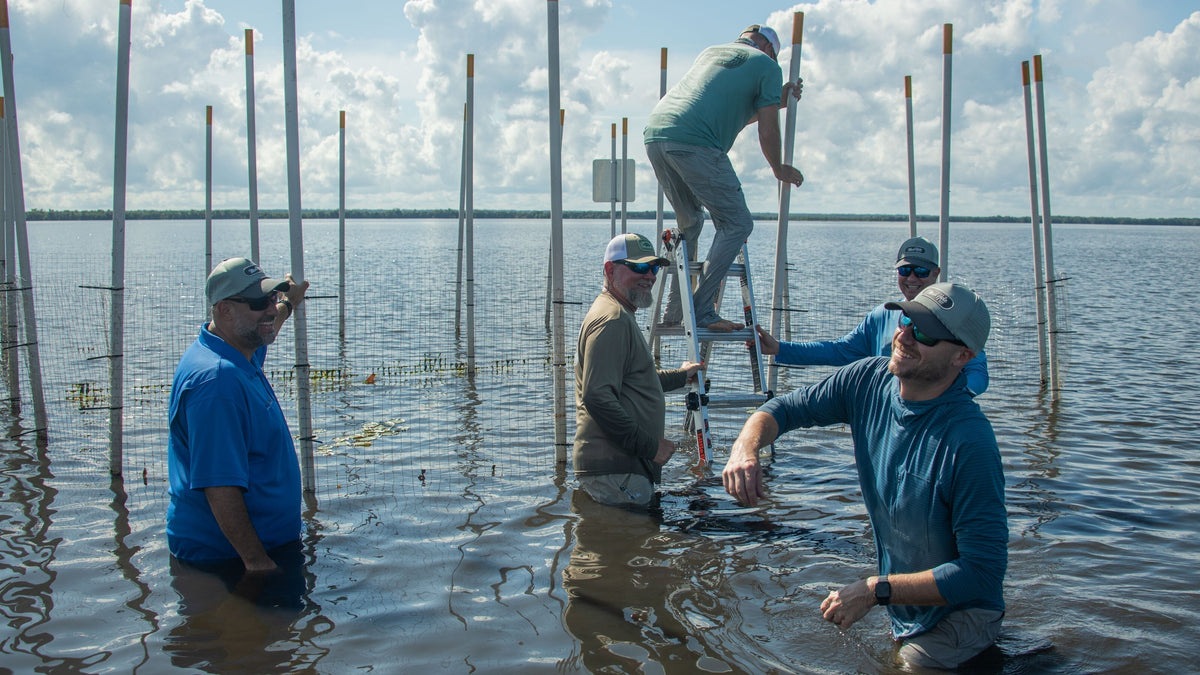
Many members of Mighty River Recovery migrated from volunteer work with the state, where efforts have been underway since 2020 to re-establish vegetation along the St. Johns River. Initial impacts from herbivores (notably turtles and manatees) showed re-growth would be challenging, initiating a vegetation enclosure program aimed at allowing SAV to get a leg up on the grass-eaters. Mighty River Recovery went one step further in 2025, designing and installing the Citizen Enclosure Project (CEP), aimed at investigating additional environmental stressors that halt growth. These 20’ x 20’ fenced enclosures keep grass-eaters out, while allowing us to experiment with numerous parameters that may be leading to declines.
While other restoration efforts investigate herbivores, the CEP initiative also looks into nutrient fluctuations, the impacts of invasive and exotic fish and the effects of herbicide use on the St. Johns River. In fact, the CEP is the only program in Florida transparently investigating the effects of herbicides on our resources.

Early in the inception of the CEP initiative, Mud Hole Custom Tackle expressed interest in joining the effort. Led by forward-thinking outdoor enthusiasts, Mud Hole understands the importance of resource protection and the value that the St. Johns River adds to Florida’s recreational economy.
A group from Mud Hole recently took their first “field trip” to the CEP units, where they learned the details of our program. This is true hands-on work, with supporters getting in the water alongside our team to live and breathe the St. Johns experience. Monitoring duties include:
• The structural integrity of each enclosure unit is confirmed first. Floating logs, alligators and boaters all make impacts on these units, requiring regular maintenance.
• Vegetation growth is catalogued. Our recent trip showed growth of both eelgrass and Mexican water lily; important fish and wildlife habitat entirely vacant outside of the test units.
• Water quality parameters are tested, through clarity measurements using a Secchi disk and temperature checks. Algae blooms are recorded. Additional stressors are monitored and recorded, including the presence of exotic tilapia and armored catfish, or how wildlife populations are utilizing the habitat.
• Finally, on a quarterly basis, dozens of water samples are taken to test nutrient parameters and herbicide presence using three laboratories across the US.
Supporters like Mud Hole, who “immerse themselves” in our CEP work, get a first-hand view of everything happening to the resource. Our pontoon-boat trip to the units includes an overview of challenges facing the St. Johns River, as well as educated commentary from our river experts on the vast wildlife populations always encountered. Many of the CEP units are within the Lake Woodruff Wildlife Refuge, where bird-life is breath-taking.

The trip isn’t all work. At the conclusion, supporters are treated to a barbecue lunch at Highland Park Fish Camp, where Old Florida remains and time ticks by at a leisurely pace. There, the proprietors have seen the ups and downs of the St. Johns River, today embracing the efforts of Mighty River Recovery to restore what was once known as the “Bass Fishing Capital of the World.” Also home to significant populations of eagles, manatees and Swallow-tailed kites, our efforts impact all.
We couldn’t do this work without our supporters. Construction, monitoring and the testing being done are extremely expensive. Each day, we learn more regarding the declines of the St. Johns River and what it’s going to take to fix them. A long-term, approach will be required, requiring thousands of hours in the field and a dedicated team willing to carry out the plan.
We’re up for the challenge.
Membership to Mighty River Recovery is free; our support is generated through donations. We ask that you consider both, and learn more here.